 EN
EN

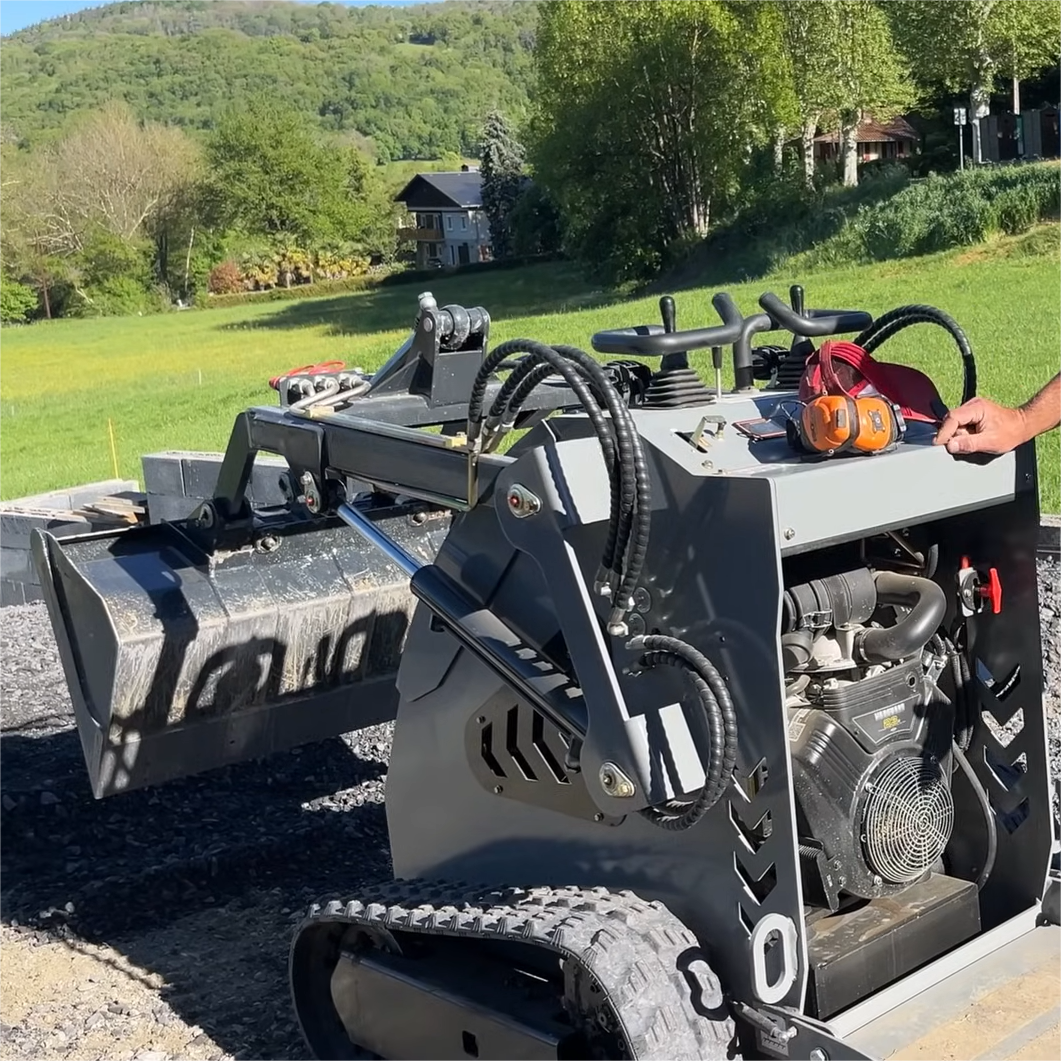
1. Product background — the rise of the track skidsteer loader in modern worksites
The track skidsteer loader has evolved from a niche compact loader into a central workhorse for construction and landscaping projects. Project timelines are increasingly compressed, site conditions more varied, and labor costs higher; these pressures favor machines that combine versatility, traction, and reliability. The track skidsteer loader answers this requirement by blending skid-steer agility with tracked undercarriage stability, enabling contractors and landscape professionals to perform a wide range of tasks with a single platform.
Historically, wheeled skid steers dominated short-term material moves and hard-surface jobs. However, as projects shifted toward softer ground, slopes, and mixed terrains, the track skidsteer loader gained prominence due to its lower ground pressure and superior flotation. This transition is driven by the need to protect finished surfaces (such as lawns and paved walkways), minimize soil compaction, and maintain productivity in wet seasons—conditions where a track skidsteer loader markedly outperforms wheeled alternatives.
From a project manager’s viewpoint, selecting a track skidsteer loader is a strategic decision: it reduces the number of specialist machines required on-site, lowers the incidence of site damage claims, and improves schedule resilience against adverse ground conditions. Moreover, the modern track skidsteer loader integrates quick-attach systems, robust powertrains, and modular undercarriage designs that simplify maintenance planning and spare-parts logistics. These attributes together make the track skidsteer loader an economically and operationally compelling choice for multi-discipline projects.
2. Product features — technical foundations that deliver operational advantages
Understanding why the track skidsteer loader excels requires close examination of three core product features: the universal quick-attach system, the rugged tracked or wheeled undercarriage, and the full-time four-wheel (or four-track) drive architecture.
Universal quick-attach system
A defining attribute of modern track skidsteer loader platforms is the universal quick-attach head. This interface supports hundreds of attachments—buckets, augers, brush cutters, trenchers, pallet forks, and cold-planers—allowing the machine to convert from earthmoving to finishing tasks in minutes. For project managers, this dramatically reduces capital expenditure: a single track skidsteer loader plus an attachment suite can replace multiple single-purpose machines, lowering fleet complexity and total cost of ownership.
Sturdy tracked or tire-based undercarriage
The track skidsteer loader undercarriage is engineered for both traction and durability. Tracked variants spread machine weight over a larger surface area, reducing ground pressure and preventing rutting on soft soils. This is invaluable in landscaping and wet-site construction where maintaining surface integrity is essential. Track constructions employ reinforced links and sealed rollers to resist debris ingress; as a result, the track skidsteer loader sustains longer service intervals under abrasive conditions. Where site conditions demand higher travel speed and puncture resistance, robust tire options are also available, providing a spectrum of configurations for the same machine family.
Full-time traction and drive architecture
The track skidsteer loader frequently features full-time four-wheel (or four-track) drive with high torque transfer. This architecture ensures consistent traction when operating attachments that impose lateral or longitudinal forces—such as grapples or stump grinders. Integrated differential locking and torque-management systems further enhance the machine’s ability to operate on slopes and through rutted tracks. For operations that require pulling, digging, and precise grading, the track skidsteer loader’s drive system maintains productivity where lesser machines would bog down.
These features—quick-attach versatility, engineered undercarriage, and resilient drive systems—combine to make the track skidsteer loader a flexible, durable, and highly serviceable asset on both construction and landscaping projects.
3. Major advantages of track skidsteer loaders in construction and landscaping
Deploying a track skidsteer loader delivers quantifiable benefits across productivity, site preservation, safety, and lifecycle economics. Below I analyze these advantages in depth, with procurement and project delivery considerations emphasized.
Productivity gains through attachment flexibility
The universal quick-attach system on a track skidsteer loader shortens job cycles by enabling rapid role changes: excavation, material handling, site cleanup, and finishing can proceed without waiting for additional machines. This reduces idle time and crew handoffs. In measured operations—such as small-scale earthworks followed immediately by grading and seeding—the track skidsteer loader keeps crews productive and reduces the number of lift-and-shift operations, directly shortening project schedules.
Superior site protection and surface finish
Track-based track skidsteer loader variants exert lower ground pressure than wheeled machines, which minimizes rutting and compaction—critical for landscaping projects and sites requiring post-construction surface quality. Lower ground disturbance reduces remediation work and preserves topsoil structure, which in turn supports faster turf establishment and less warranty exposure. For hardscape projects, the track skidsteer loader's controlled traction avoids chatter marks and scuffs on pavers, delivering improved final appearance and client satisfaction.
Terrain adaptability and all-weather capability
Construction sites are dynamic; mud, snow, and loose aggregates are common. The track skidsteer loader maintains traction across these conditions, enabling continuous operation where wheeled loaders would need anti-slip measures or tow assistance. The machine’s differential-locking features and full-time drive translate into fewer stoppages, reduced need for labor-intensive stabilization, and a lower incidence of stuck-vehicle recoveries that drain management time.
Operator safety and control
Because the track skidsteer loader distributes load and offers a stable platform, attachment control is more predictable—particularly when using high-reach or heavy-duty implements. Predictable behavior reduces operator corrective inputs and the likelihood of load swings or tip events. Additionally, many track skidsteer loader cabins incorporate improved visibility, ergonomic controls, and electronic stability aids, all of which contribute to fewer near-miss incidents and lower insurance exposure for contractors.
Maintenance efficiency and lifecycle cost
A well-designed track skidsteer loader simplifies routine maintenance: centralized grease points, modular wear components, and sealed undercarriage systems reduce downtime. Although tracked machines may present higher initial component costs compared to wheeled variants, their ability to avoid surface-related repair work and maintain consistent production under harsh conditions often results in lower lifecycle cost per operational hour. For project managers, this means more predictable maintenance budgets and longer intervals between major services.
Fleet rationalization and procurement advantages
By standardizing on a track skidsteer loader platform with a comprehensive attachment library, organizations can reduce the number of distinct machine types they need to purchase and service. This improves spare-parts commonality, simplifies operator training, and concentrates maintenance expertise—delivering procurement leverage and lower indirect costs.
Collectively, these advantages make the track skidsteer loader particularly compelling for mixed-use projects where earthmoving, material handling, finishing, and surface-sensitive work occur in close sequence.
4. Case vignette and implementation considerations
Consider a mid-sized urban redevelopment project with landscaped courtyards and tight site access. A single track skidsteer loader assigned to this scope performed grading, installed drainage, transported palletized materials, and assisted with light demolition using a breaker attachment. The tracked undercarriage preserved the landscaped subgrade while enabling stable breaker operation on compacted concrete. Result metrics demonstrated reduced equipment turnover, a 15% improvement in moves-per-hour compared to wheeled loaders in similar tasks, and fewer rework incidents on finished surfaces.
For project managers planning to integrate a track skidsteer loader, key implementation steps include: defining the attachment mix based on scope, specifying undercarriage type (track vs. tire) relative to ground sensitivity, planning preventive maintenance intervals aligned with projected hours, and implementing a targeted operator training program that covers attachment exchange, load management, and undercarriage inspection. Evaluating total cost of ownership should account for avoided surface repairs, reduced equipment shuttle time, and improved labor utilization.
Conclusion
From the perspective of project delivery and asset management, the track skidsteer loader is a versatile, site-resilient machine that enhances productivity, reduces surface damage, and simplifies fleet logistics. For construction and landscaping programs that require agility plus ground-friendly performance, integrating the track skidsteer loader into your fleet strategy delivers measurable operational and financial benefits. Shandong Nuote Machinery Co., Ltd. offers engineered track skidsteer loader solutions designed to meet these demands, supporting reliable project execution across diverse site conditions.